
For a long time as a child, I immersed myself in fantasy. I cut my teeth on Narnia, then the Hobbit, the early Dragonlance novels (Chronicles and Legends and the like), then eventually the Drizzt Do’Urden novels, and the rest of the Forgotten Realms among others. For many years, I stayed there, mostly because it reinforced my gaming habits of Dungeons & Dragons. It was where I spent my money, buying sourcebooks and reading material. It was where I spent my time, making characters, maps, and adventures for the gaming groups that I mostly did not have. But after something like fifteen or so years of doing so, I felt like I needed a change, and so I did what had become somewhat commonplace by then – I turned to the internet for help.
I wanted to stay within the fantasy and science fiction realms because it was what I knew, but I needed something different. So I started browsing forums and sites talking about authors that people enjoyed who also enjoyed those things. That was how I first became acquainted with Jim Butcher. It was maybe 2004 when I first picked up Storm Front. And when I came across the words:
“My name is Harry Blackstone Copperfield Dresden. Conjure by it at your own risk. I’m a wizard. I work out of an office in midtown Chicago. As far as I know, I’m the only openly practicing professional wizard in the country. You can find me in the yellow pages, under ‘Wizards’. Believe it or not, I’m the only one there.”
Storm Front, Jim Butcher
I was hooked. Sure, I had played Shadowrun by then. The idea of modern magic in our world wasn’t new to me, per se. But the casual way that Butcher’s Harry Dresden stepped into that role stole my attention. Since then, those characters and many others have taught me to look for magic in our world with every bit as much believability as in Tolkien’s Middle Earth and Greenwood’s Faerûn. That dear readers, is what jumpstarted my excitement about the toolbox supplement It’s Only Magic from Monte Cook Games when it appeared on Kickstarter in early 2023.
Art and Production
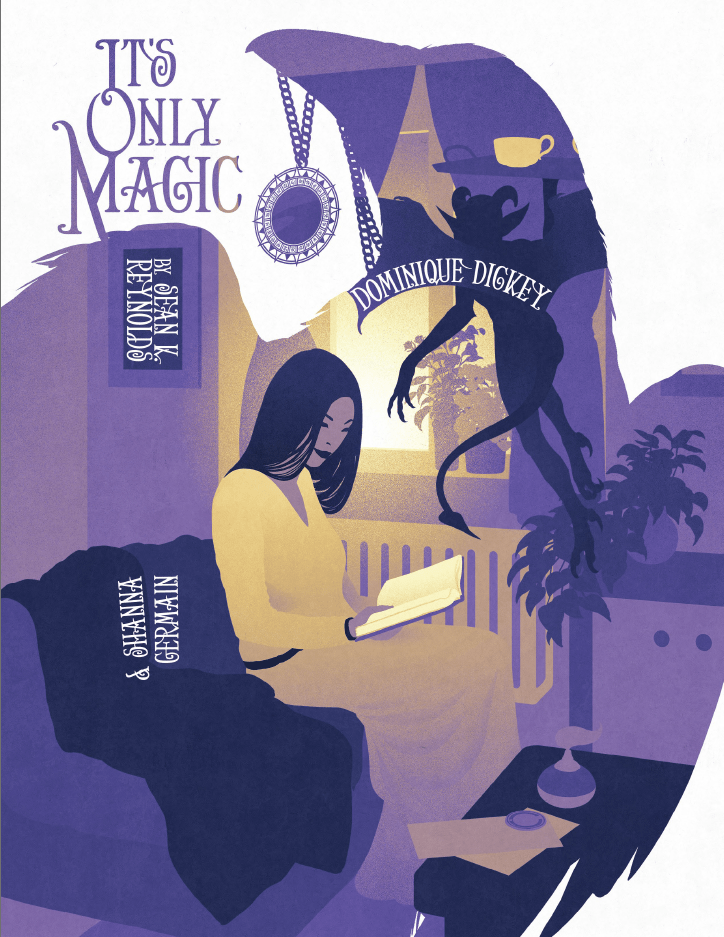
It’s Only Magic is a 240-page toolbox book for urban fantasy by Sean Reynolds and Shanna Germain with Dominique Dickey. Like the rest of the toolbox books they’ve released, Monte Cook Games has once again released a quality offering. Their publisher remains on-point with solid-quality pages and binding that can withstand use as well as shelf-time. Under Art Director Bear Weiter, the layout and art are high quality and thematic (we’ll get to art more in a few moments). The book’s setting comes with a poster map of Colvin’s Park, a city map that is also of excellent quality. Those of you who have ever been subscribers to our Patreon know how much I love me a good map. The colors, which are something I often struggle with getting right, are warm and easy to read and feel very much like the cottage-core that seems to underpin the sourcebook itself.
Content
One of the first things you’ll come across in the book is a list of potential genre flavors along with inspirations for such flavors. I’ve been a fan for a long time of putting examples of things from other media in TTRPG rulebooks. Consuming other media is a useful thing for both players and GMs to draw inspiration from and serves as an excellent springboard for ideas. The very next chapter is a detailed walkthrough of some of the important stops you’ll make as you build your game world. These are things to consider and have answers for as they will make the whole setting seem more real and vivid to the players. Additionally, when you aren’t feeling very inspired, at the end of the second chapter, there is a set of tables that will roll up a set of answers to those questions to give you something to springboard off of. I prefer cards, personally, but for prep, tables will work just fine.
The next chapter has a massive 100-item-long list of story ideas for your inspiration and also talks a little about story and plot. The following chapter talks about playing and running modern fantasy, particularly in an urban setting. In this one, there are additional character arcs provided that have a thematic bent for the genre. As a big fan of character arcs and as someone who uses the idea in other games that don’t inherently have them, it was nice to see this add-on. Next up are descriptors. These are almost completely related to “species” with only one exception and pair similarly with the ones in Godforsaken.
The following chapter contains some incredibly cool new Foci like Codes Magic Apps, Conjures Bullets, Inks Spells on Skin, and Steers the Coven. Additionally, it adds quite a few new Character Abilities to go with them. But this chapter also contains what is, in my humble opinion, possibly the greatest single page of an RPG of all time. The artwork and the ability pair more perfectly than anything I have ever seen. I hope that Monte Cook Games forgives me, but it absolutely must be seen to be appreciated. So without further ado, I give you… the Remote Slap.
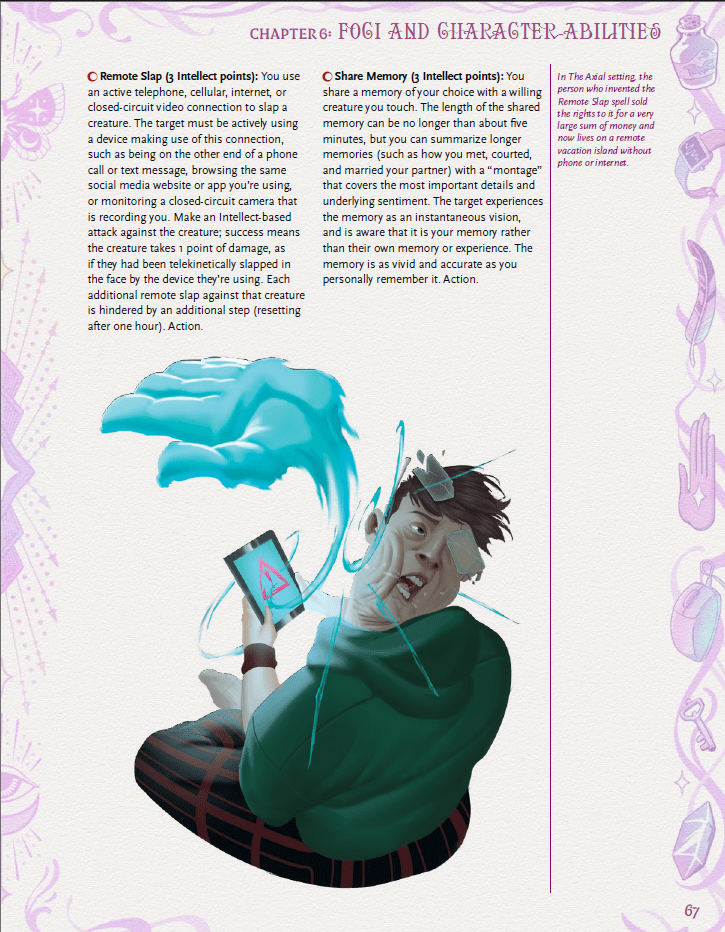
I don’t know about any of you, but I absolutely need this in my real life for… reasons.
The next chapter adds some new Flavors to modify your Character Types the way the core book does. This is the first toolbox to add additional Flavors this way, and if I’m completely honest, they all kind of interest me in different ways (which, to me, is a mark of good mechanics – they offer choice). After that, we have modern fantasy equipment, set up the same way as in the Cypher Rulebook. And then there are some additional rules modules. The crafting rules are a simplified subset of the Numenera ones, and while there are not really any abilities like those of the wright that ease crafting tasks (except for Magical Programmer and Master Magical Programmer to go with the Codes Magic Apps Focus), there are a few Cyphers and an artifact listed that help as well as the ability to take skill ranks in magical crafting or something similar using advancements and/or XP.
The next three chapters deal with Creatures and NPCs that you might find in an Urban Fantasy setting as well as Cyphers and Artifacts that might go in such a setting. As with everything else in the Cypher System, these can be aesthetically reskinned to match your setting with no effect on how they work. Cyphers, as the namesake of the system offer one-shot powerful abilities in a consumable way similar to potions or scrolls in a game like Dungeons & Dragons. Artifacts, on the other hand, are repeatable abilities, like magic items that occasionally deplete and are used up, but in theory, can be reused many times.
It’s Only Magic is unique in that it actually provides two settings rather than just one. The first is called the Axial and it features a quasi-urban cozy fantasy city called Colvin Park. The second is a strange small community called New Grimsby. Each of the two has a bit of a different feel to them with Colvin Park feeling more contemporary (almost like you could turn a corner and find and attend Brakebills from The Magicians television show), while New Grimsby feels more like Twin Peaks or Gravity Falls. Both illustrate quite well ways you can arrange the pieces of the toolbox to suit a different feel of game. The three adventures presented, all seem to fit particularly well in the Axial setting provided, though they could, with a little adjustment, fit in most modern fantasy games.
Critique
Probably the very first thing that sticks in my craw is the Equipment. In Godforsaken, the fantasy toolbox book, the equipment was presented in both the Cypher method of “Categories” (Inexpensive, Moderately Priced, Expensive, Very Expensive, and Exorbitant). It was ALSO presented using precious metal equivalents. In a modern fantasy setting, it would seem to make sense to offer the same sort of thing in an American Dollar, or Euro, or Yen equivalent, or something. I only bring this up because for me, personally, I have a hard time awarding monetary rewards in terms of categories. I understand that tracking money is more accounting and character sheet math, but it’s what I’m used to. It’s a “nitpick” for me. Just offer both (a second column would be just fine).
I almost put a critique in here about the Modern Fantasy Rules Modules, as in, why aren’t there more, but it occurs to me that mostly everything I could think about was covered (or will likely be covered) in an existing (or upcoming) toolkit book. (Sean, where is my copy of Neon Rain? I want it. Now. You’re killing me with this waiting bit. Killing. Me.) So I really can’t complain about that. I would have liked to see a couple of Cypher Shorts in the Adventures chapter in addition to the three full-sized ones. And a map of New Grimsby would have been nice, perhaps on the back of the poster map of Colvin Park. Outside of that, I don’t really have any other complaints.
Summary
All in all, It’s Only Magic is another excellent addition to the toolbox series of white books for Monte Cook Games’ Cypher System. It adds quite a bit of functionality that is easily paired with the other books (in my mind, particularly Stay Alive, We Are All Mad Here, and Godforsaken) to give a highly refined dial with which a GM may tune their game to get a particular feel. As with all of these, even if the style of setting is not your type (the way Claim the Sky or First Responders aren’t mine), they are useful for pulling bits and pieces of Abilities, Descriptors, Foci, Rules Modules, and other things from. Give it a look at the Monte Cook Games Store or DriveThruRPG and Happy Gaming!
- Josh Walles

 Storytelling and Gaming
One thought on “Review: It’s Only Magic”