
One of the things that we at Angel’s Citadel have tried to do is to be open and willing to help small, independent creators get their products in front of a wider audience. Chasing people down has never been our thing, but when they come to us, we try to help where we can. Admittedly, our schedule is much busier than it used to be these days. Both of us work, we have our efforts with the local club that we’re running, exposing them to a variety of games, and we have our own projects that we are working on (Hope’s Horizon – yes, it’s still coming – and a “Super Sekrit”™ project that Joann is playing with some initial layout on in order to get it ‘readable’ for playtesting). However, since we’re trying to continue our efforts here, I thought I’d try and work in a request that was made of us.
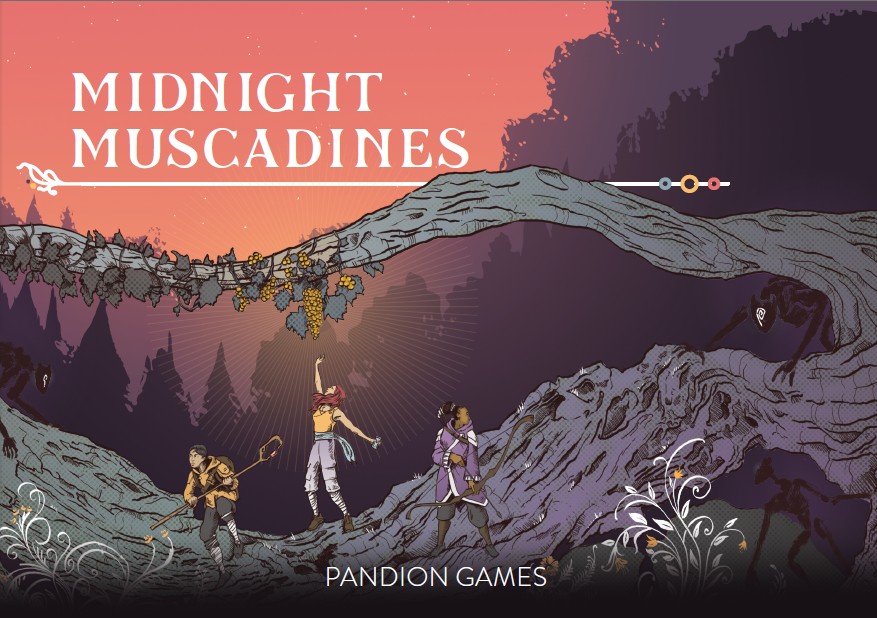
Several weeks ago, the team from Pandion Games asked if I would take a look at the press copy of their game Midnight Muscadines. It was a game that seems to have been made on a dare given by some other friends of ours: Sean and Navi Drake over at A Couple of Drakes. Now, I’ll be the first to admit that the mashup of tabletop roleplaying games and edible jams and jellies was not one that ever appeared in my dreams, exhaustion-induced or otherwise, or even my nightmares. As someone who has never spent any time using recreational drugs, it obviously hasn’t shown up there either, though for some strange reason, the Caterpillar, or perhaps the Mad Hatter from Alice’s Adventures in Wonderland, present themselves as potential sources for the idea. And I will freely admit that I had absolutely no idea what a Muscadine even was, something which Joann found hilarious as she explained it to me from her vast knowledge of things that I don’t know about (no, that’s not sarcasm – we both know tons of things the other doesn’t). With all that being said, however, as I started to read my way through the rulebook provided, I found myself strangely intrigued by the way the idea settled. So without further ado, let’s dive into the content.
Manufacturing Quality
As I only received the electronic press copy (since it is still in production), I can’t speak to the actual physical production content of this book. It was funded with a remarkably successful Bakerkit campaign that reached it’s goal in ninety minutes and over the campaign, accumulated seven times its goal amount. The physical book is going to be an A5 landscape print. If I’m honest, that’s not my favorite format, mostly for how it fits on a standard shelf compared to all my other books. That isn’t to say that I don’t have a couple of books in that format, but it’s only a handful.
On the visual layout, however, I have to say that it’s one of the better aesthetic palettes I’ve ever run across. Easy on the eyes, the muted yet warm tones of deep purple, auburn, and something like a honey gold or even amber evoke the ‘cozy-ness’ of the game that it is fairly obvious that the designers were targeting. The font choice is not harsh either, with the subtle greyish-blue colored background contrasting in a way that softens the text further than a standard white page, making it even less straining to the eyes – another way the design team “welcomes” you into the book. The Card Deck follows the aesthetic of the book, and can act as a simple random draw based on the many tables in the book, or as a stand-alone oracle, with many prompts and ideas to aid the storyteller. The Character Sheet is cute, stylized around jam containers, but compared to the excellent visual layout in the book, it seems almost like an afterthought.
Content
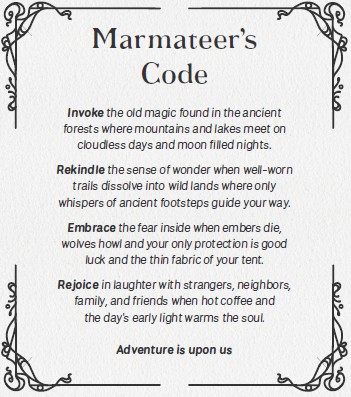
The game itself, as well as several of the reviews, suggest that if the reader enjoys the films popularized by Studio Ghibli, they will enjoy this book. They are probably not wrong. As someone who backed a Kickstarter for a 5E setting that attempted precisely this, it occurs to me that I don’t have very many such settings in my collection, large as it already is. The code of the game’s adventurers, known as Marmateer’s, sets a theme that seems to agree with that sentiment.
Midnight Muscadines is playable as either a traditional group-and-storyteller game, or solo (as Ironsworn or its Science-Fiction counterpart, Starforged are) using an oracle system. The game is set in the world of Nimm, a world broken after its people turned on Tume, the goddess they feared, throwing their existence out of balance. Tume’s brother, Valgus, in rage, turned against them, but they captured him and sealed the once benevolent light-bringer away, using shards of the sun he’d destroyed to keep the Wildernight at bay. Shadows from the Wildernight seek the return of Valgus, and so the Marmateers stand ready, collecting ingredients to craft magic for the aid of their people. To play, you need a full set of polyhedral dice, as well as a deck of playing cards, shuffled, with the Jokers removed.
Character creation consists of first choosing which Folk you will be from an assortment of ten that actually manage to feel unique as opposed to the traditional elf, dwarf, halfling, or similar races. Next, you choose your Background, or the life you came from before you were a Marmateer. This helps you determine your Attributes, maximum Endurance, Protection, and starting Abilities. After that, you craft your Marmateer’s Jar (sketch it on your character sheet).
“The jam jar a Marmateer carries is crafted by filtering the magic from Muscadines into a pure, crystalline form. Each jar is unique to the Marmateer.”
- Midnight Muscadines, p. 30
You then add two ingredients (by card draw using the ingredients table), using one of them to craft a pure jam, giving you a spell. You add an item into your inventory next that can be simply imagined or can be a card draw. Next, you join a second Guild and note its benefit. Finally, you add some details: a Name, Pronouns (these two are changeable at any time), a Style, and a Quirk. That’s it. That’s your character.
Characters advance in two ways – gaining experience through successful Checks and gaining Renown through accomplishing tasks. When you gain ten experience, clear your XP track, gain one Renown, and draw a card. The suit of the card tells you which modifier you gain. If the modifier would become +4, remove it and instead step up the die (a d4 becomes a d6, a d6 becomes a d8, etc.). You spend Renown to obtain larger mechanical benefits. The player and storyteller are encouraged to describe a vignette or play out a montage of gaining the new benefit.
Players use dice to perform Checks when the outcome of their actions is uncertain and reveal cards when prompted, acquiring cards during Setbacks and burning them to use abilities, alter jams, and empower their items, spells, feats, or Protection. Cards revealed or burned are placed in a discard pile. When the deck is empty, the discard pile is shuffled to create a new deck. In the unlikely event that there are no cards in the discard pile to shuffle, players must discard all black cards from their hands and then shuffle them to create a new deck. Dice rolls are typically made against Difficulty Ratings, which typically range between five and fifteen, and can be randomly chosen in a solo game with a suit-draw from the card deck. These difficulty ratings can also be adjusted by Risk, a mechanical tuning based on the narrative situation the characters are in.

Beyond this, there are specific rules for Challenges and Adversaries, Player and Adversary Actions, Conditions, Non-Player Characters and Companions, and Travelling. These are followed by rules dealing with the creation of the Magical Jams that Marmateers are known for. The next section is nine pages on playing Midnight Muscadines solo (without a storyteller). Then there are about twenty pages on creatures and interesting people you might meet in Nimm and the Wildernight. The artwork is sometimes simplistic, and sometimes charmingly simple (it is something of a mixed bag). Then come thirteen pages full of oracles that are based on card draws for a whole host of situations that can either be used to aid the storyteller looking for inspiration, or to provide the solo player with surprises. Also included are some adventure hooks (both Background- and Guild-inspired) to get you started.
The following section has several pre-written adventures to get new players and storytellers started in the world of Midnight Muscadines, either from the perspective of those in Nimm or those in the Wildernight. The last section of the book, and also the largest, outlines the high points of the setting of the game. It lists the Guilds, the seasons of the year (important to know considering how magic comes from the growth of living things), the Festivals observed throughout the land, the towns found around Nimm and some things and places that you will find in the Wildernight. Finally, it speaks of the pantheon of Gods and Great Spirits and their motivations for acting in the world (or retreating from it).
Critique
Aside from the format not being what I personally prefer (even a portrait 6 x 9 book like FATE or Blades in the Dark would be preferable in physical copy), the only real criticism I have of the game is that I feel like a person reading the book could benefit from an example character creation. Perhaps have something similar to what was done at the beginning of the Dungeons & Dragons 5E Players Handbook or the Shadowrun 6E Core Rulebook, where they walk through creation from a player’s point of view and illustrate the decision-making process. Additionally, some more examples in the “How to Play” section, particularly dealing with Making Checks, and interacting (combat and non-combat) with Non-Player Characters and Adversaries. It would be useful to see that in some sort of combined example that also showcases how to use the Creature stat blocks (perhaps at the end of the chapter on Creatures & Folks.
Outside of that, I think the rules are, for the most part, simple enough that the treatment in the book is sufficient. I, for one, will never turn down more setting, particularly if it is less canonical factual knowledge and more about how something feels, looks, or is experienced. The more that is done, the more the world comes alive for me and the easier a time I have painting it for my players to imagine.
Summary
Midnight Muscadines is a tabletop role-playing game by Andy Boyd and the team at Pandion Games. A low-complexity cozy-dark fantasy game, it blends some unique (and I still maintain at least partially Caterpillar-instigated, drug-induced) narrative concepts along with some simple dice and card mechanical ones to offer a surprisingly varied setting to satisfy your cottage-core, Studio Ghibli-like cravings. We would absolutely recommend checking this out. You can find more information at Pandion Games’ website, which has a link to their pre-order page on Backerkit. I know we’re not reviewing as often as we used to, but we’re still here, we’re still playing and checking out new games, both those we backed via crowdfunding and otherwise. So from our Citadel to yours, Happy Gaming!
- Josh Walles

 Storytelling and Gaming